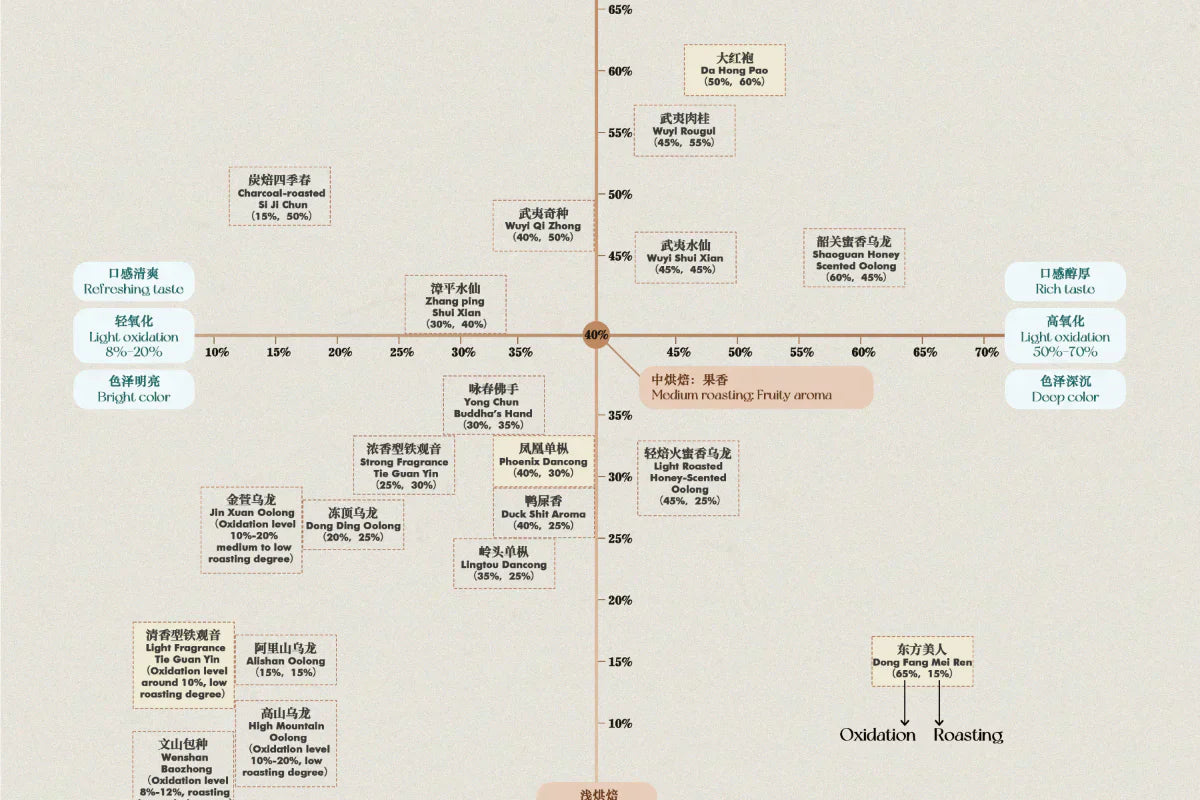
When people talk about Oolong tea, the first thing that often comes up is the roast level. Lightly roasted Tie Guan Yin, medium roast Phoenix Dancong, and heavily roasted Wuyi Rock teas like Da Hong Pao or Wuyi Rougui are the main varieties. Generally, the higher the roast, the higher the oxidation, so oxidation and roasting levels go hand in hand. Here's what I’ve learned about the impact of these factors:
Oxidation primarily influences the aroma and the freshness of the tea’s flavor. Light oxidation gives you a fresh, floral fragrance, while heavy oxidation brings a more mature and intense nutty or honey-like scent.
Roasting affects the lasting power of the aroma and the depth of the flavor in the tea. Light roast keeps the fresh fragrance intact, while heavier roasting gives the tea a richer, fuller taste, with hints of toasted or even charcoal flavors.
Oxidation mainly determines the flavor profile and the type of fragrance, while roasting adjusts the depth of the taste, the persistence of the aroma, and the color of the liquor.
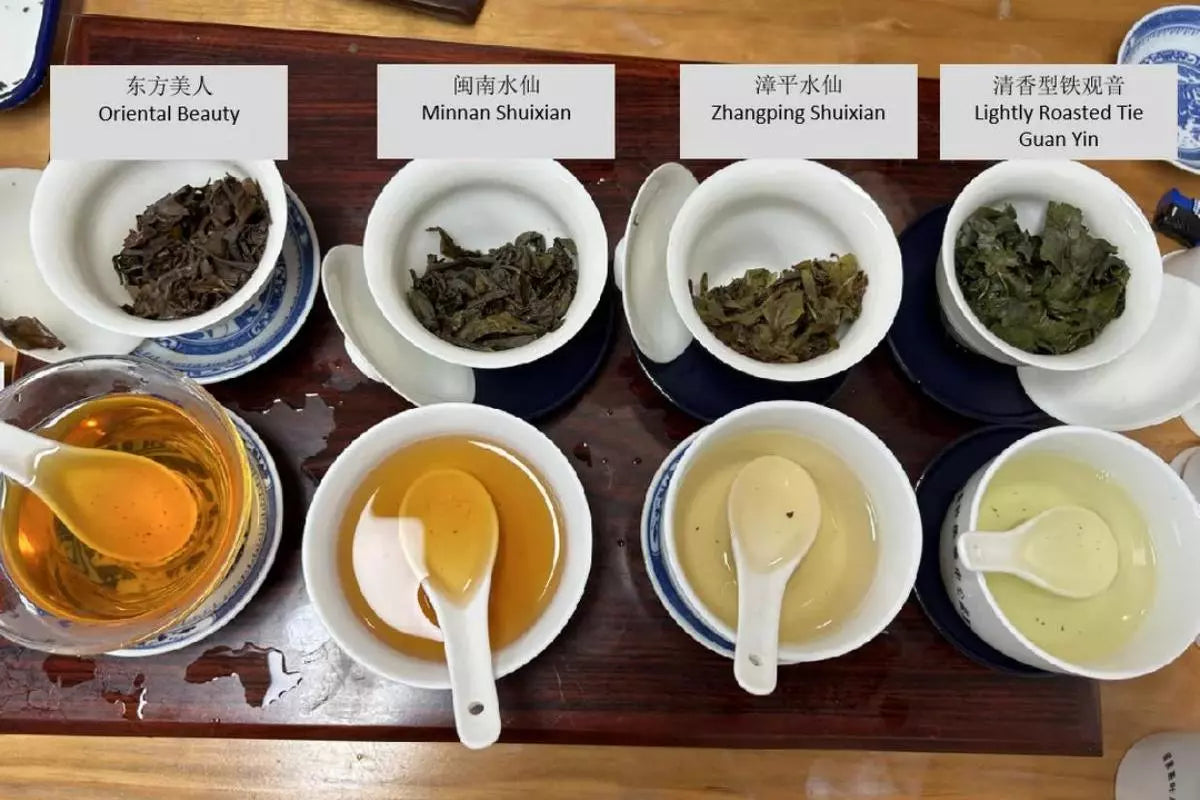
I picked a few teas to compare: a lightly roasted Tie Guan Yin, Zhangping Shuixian, Minnan Shuixian, and Oriental Beauty. These four all come from Fujian, with roughly similar roast levels (all lightly roasted), but different oxidation levels. One thing I didn’t factor in is that the tea cultivar and other processes might not be exactly the same.
Here are the oxidation levels:
Tie Guan Yin: Light oxidation (10-20%)
Zhangping Shuixian: Mild-light oxidation (25-30%)
Minnan Shuixian: Medium oxidation (40-50%)
Oriental Beauty: Heavy oxidation (60-70%)
These four types of Oolong tea, with varying oxidation levels, are part of our Oolong Tea Oxidation Degree Collection. If you’d like to explore the different factors that influence the quality of Oolong tea, we welcome you to purchase and experience them yourself.
Roast levels:
Tie Guan Yin: Very light roast, 70-80°C (158-176°F)
Zhangping Shuixian: Very light roast, 70-80°C (158-176°F)
Minnan Shuixian: Very light roast, 80-90°C (176-194°F)
Oriental Beauty: Very light roast, 70-80°C (158-176°F)
The lightly roasted Tie Guan Yin and Zhangping Shuixian are easy to find, but it's much harder to find lightly roasted Minnan Shuixian because it’s typically processed using a method more similar to Wuyi Rock tea, which focuses more on roasting. (By the way, Tie Guan Yin, Zhangping Shuixian, and Minnan Shuixian also have medium roast versions, so if you’re interested, you could try those as well.)
The lightly roasted Oolong teas bring out purer, more distinct aromas, and are perfect for tea lovers who prefer clean, high-flying fragrances.
Now, what exactly does the difference in oxidation do to the tea?
Brewing:
Use a gaiwan with 100°C (212°F) water. Use 5g of tea with 100ml of water, steep for 10-15 seconds for the first 1-3 brews. (Since Zhangping Shuixian is compressed into blocks, the first brew needs to be 15 seconds, but after that, the steeping time can be the same as the other teas.)
Liquor and Leaves:
Teas with different oxidation levels are actually pretty easy to tell apart, much like green and black tea. Green tea isn’t oxidized, while black tea is fully oxidized. Lightly oxidized Oolongs, like Tie Guan Yin and Yongchun Buddha’s Hand, still have a thicker, smoother mouthfeel than green tea and their aromas are more intense. As oxidation increases, the tea’s color turns more orange-red, and the leaves shift from green to reddish-brown.
Aroma and Taste:
Lightly Roasted Tie Guan Yin:
The floral orchid scent is very noticeable—whether in the air or in the cup. What’s important is that it’s not bitter or astringent at all. I believe anyone who enjoys green tea would love to try lightly oxidized Oolong tea.
Zhangping Shuixian:
On its own, you can really get the scent of orchid and osmanthus—floral but with a slightly sweeter touch. The liquor is smoother than Tie Guan Yin, and the water feels sweet without any grassy taste. However, when compared to Tie Guan Yin, the floral fragrance isn’t as strong or distinct. I think this is why Tie Guan Yin is so popular, while Zhangping Shuixian is less appreciated. But if you like a more balanced, sweet floral Oolong, you should definitely give it a try.
Minnan Shuixian:
This lightly roasted Minnan Shuixian is actually made from raw tea of the Minnan Shuixian cultivar, which is actually a variety of Minnan Bei Shuixian (Northern Minnan Shuixian). It was dried at a low temperature without undergoing the roasting process. This is my first time trying it, and the flavor is intense, with a noticeable roasted nut aroma, but it also has a slight astringency because it wasn’t roasted. Overall, the flavor is more complex. Since it wasn’t roasted at high temperatures, there’s no smoky flavor in the tea. I’ve tried many Minnan Shuixian teas before, and the roasting process in those teas didn’t integrate as well as in Wuyi Rock tea, but this unroasted version is surprisingly clean and clear. My female friends particularly enjoy this pure, layered taste.
Oriental Beauty:
This version of Oriental Beauty is made from tea leaves from Sanming in Fujian, not Guangxi. The Taiwanese versions are more expensive. Because of its high oxidation and light roasting, it’s very close to black tea, but it has a smooth silkiness and a refreshing taste that black tea lacks. It’s sweet with no sourness or bitterness, and has an elusive fragrance that’s hard to pinpoint. This is a unique flavor that red teas can’t quite match. If you enjoy delicate, fragrant red teas, you should definitely give Oriental Beauty a try. It truly lives up to its name—an elegant, understated beauty from the East, with depth and charm.
Like me, my friends love these four Oolong teas with different oxidation levels and light roasting. They each have their own style, and it really shows how oxidation determines the flavor profile and aroma of the tea.