

How to Truly Understand Oolong Tea? — Decoding the Flavor Profile of Oolong Tea
Oolong tea comes in many varieties, but the key factors that influence its flavor and aroma are: different oxidation levels, roasting degrees, tree ages, altitudes, seasons, and soil environments. To help you navigate the complex world of Oolong tea, we’ve created 6 different sample sets that highlight these factors. These sets are designed to help you discover the flavor rules of Oolong tea, making it easier to find the taste that suits your preferences. We hope these products will help more people make informed choices when buying Oolong tea.

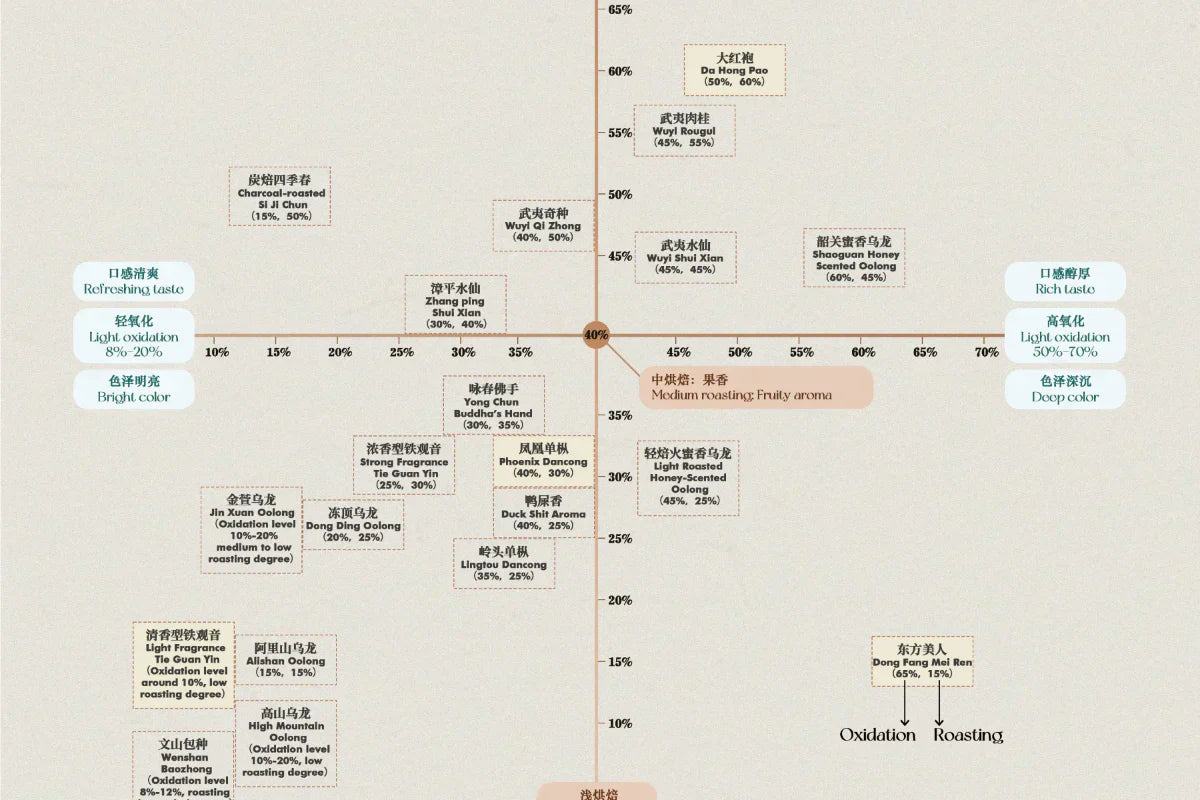
Among these factors, oxidation level and roasting degree have the most significant impact on the flavor of Oolong tea. Even if you're new to Oolong tea, you’ll be able to notice how these two factors dramatically change the tea’s aroma and taste. To truly understand Oolong tea, you need to start by understanding how these two elements work.
What’s the Difference Between Oolong Teas with Different Oxidation Levels?
Oolong tea is a semi-oxidized tea, with oxidation levels ranging from 10% to 70%. The oxidation level mainly affects the type of aroma and the freshness of the taste. Light oxidation brings out fresh floral and fruity notes, while heavy oxidation results in more mature and intense fruity or honey-like aromas.
- Lightly oxidized Oolong tea (10%-25%), such as Wenshan Baozhong or light Tieguanyin, typically has a fresh, floral, and fruity aroma.
- Moderately oxidized Oolong tea (25%-50%), like Phoenix Dancong or rich-flavored Tieguanyin, still has noticeable floral notes, but they are often mixed with honey, fruit, or roasted aromas, creating a more balanced and complex flavor.
- Heavily oxidized Oolong tea (50%-70%), such as Da Hong Pao, Wuyi Rougui, or Oriental Beauty, has a more pronounced ripe fruit, roasted, or caramel-like aroma, with a smoother and more mellow taste.
Our product — Oolong Collection by Oxidation Levels — includes 4 well-known Oolong teas with the same light roasting but different oxidation levels, so you can explore how oxidation affects the flavor.
This set includes:

This set includes:
- Fresh Tieguanyin (Light Oxidation)
- Zhangping Shuixian Oolong Tea (Medium-Light Oxidation)
- Minnan Shuixian (Medium Oxidation)
- Oriental Beauty (Heavy Oxidation)
Does Heavily Roasted Oolong Tea Always Have a Smoky Flavor?
The main purpose of roasting Oolong tea is to reduce moisture, remove unwanted flavors, and lower caffeine content, while concentrating the tea’s aroma and taste. Different oxidation levels often require different roasting degrees. Generally, low oxidation pairs with light roasting, which enhances the tea’s natural flavors. However, if a tea is lightly oxidized but heavily roasted, you might taste a strong roasted flavor, which is often used to mask insufficient oxidation.
- Light roasting preserves the tea’s fresh and floral notes.
- Heavy roasting makes the tea more full-bodied, with toasty or charcoal-like flavors.
Our product — Wuyi Rougui Oolong Collection by Roast Levels — features Wuyi Rougui from the same region and made by the same master, but with different roasting levels, so you can fully understand how roasting impacts the flavor.
- Lightly Roasted Wuyi Rougui (Floral)
- Balanced Roast Wuyi Rougui (Classic Style)
- Medium Roasted Wuyi Rougui (Rich & Toasty)

Does Altitude and Season Really Matter for Oolong Tea?
After oxidation and roasting, altitude and season also significantly influence the flavor of Oolong tea. It’s not always true that spring tea or high-altitude tea is the best. Different altitudes and seasons produce unique flavor profiles, and you’ll need to taste them yourself to understand the differences. These factors are also noticeable even for beginners.
Is High-Altitude Tea Worth It? This Product Might Give You the Answer
High-altitude regions have large temperature differences between day and night, cooler climates, and frequent fog, which slow down the growth of tea leaves. This results in higher levels of theanine and richer compounds in the leaves, leading to sweeter, fresher, and more aromatic tea. High-altitude teas are usually lightly to moderately oxidized and roasted. Examples include Taiwan High Mountain Tea and Phoenix Dancong.
On the other hand, low-altitude teas tend to have more polyphenols, weaker aromas, and are less durable for multiple infusions.
Our product — Ya Shi Xiang Dan Cong Oolong Collection by Altitudes — includes three Ya Shi Xiang (Duck Shit) Dan Cong teas from the same region and made by the same master, but grown at different altitudes, so you can compare the differences.
This set includes:
- Ya Shi Xiang (Low-Mountain)
- Ya Shi Xiang (Medium-Mountain)
- Ya Shi Xiang (High-Mountain)

Is Spring Tea the Best for Oolong, Just Like Green Tea?
Oolong tea can be harvested in four seasons: spring, summer, fall, and winter. However, Wuyi Rock Tea is only harvested in spring. Generally, midday harvests produce the most aromatic teas. Summer teas are mostly used for milk tea and rarely appear in the loose-leaf tea market. Spring teas grow slowly, with higher amino acid and polyphenol content, but due to frequent rain in Fujian and Guangdong, their aroma might not be as strong as autumn or winter teas. Winter teas even have a cool, crisp aroma, while spring teas are richer in flavor and sweeter.
Our product — Ya Shi Xiang Dan Cong Oolong Collection by Different Seasons — includes three Ya Shi Xiang teas from the same village and made by the same master, but harvested in different seasons. These teas have different oxidation and roasting levels, as Oolong tea production is tailored to the tea leaves. Winter leaves are thinner, so they are lightly oxidized and roasted. Try them to see if you can taste the seasonal differences.
This set includes:
- Ya Shi Xiang (Spring)
- Ya Shi Xiang (Autumn)
- Ya Shi Xiang (Winter)

Do Tree Age and Soil Environment Really Affect Oolong Tea?
The first four factors are noticeable even for casual tea drinkers, but the influence of tree age and soil environment requires a more refined palate. We recommend these for more experienced tea enthusiasts.
You Might Not Like Century-Old Tree Tea
Both Pu’er and Oolong teas often emphasize tree age. Generally, older trees are rarer and more expensive. In Oolong tea, tree age is most notable in Shuixian varieties (like Phoenix Shuixian, Wuyi Shuixian, and Minbei Shuixian). Younger trees have higher amino acid content, making the tea sweeter but less complex, with a more pronounced varietal aroma. Older trees, on the other hand, have richer polyphenols, fiber, and minerals, resulting in sweeter, more enduring aftertastes, and better durability for multiple infusions.
Our product — Shuixian Oolong Collection by Tree Ages — includes Phoenix Shuixian and Wuyi Shuixian from the same region and made with the same process, but from trees of different ages, so you can compare the differences.
This set includes:
- Phoenix Shuixian (Under 30 Years)
- Phoenix Shuixian (30-70 Years)
- Phoenix Shuixian (Over 70 Years)
- Wuyi Shuixian (Under 30 Years)
- Wuyi Shuixian (30-70 Years)
- Wuyi Shuixian (Over 70 Years)

How Does Soil Environment Affect Oolong Tea?
The most classic example of soil influence is Wuyi Rock Tea. As Lu Yu’s The Classic of Tea states, “The best tea grows on rocky soil, medium-quality tea on gravelly soil, and lower-quality tea on yellow soil.” Rocky soil provides good drainage and aeration, and is rich in minerals, making it ideal for tea trees. The best Wuyi Rock Tea grows on rocky, gravelly soil, while Zhou Cha (grown on yellow soil) is considered lower quality, with less complexity and a weaker aroma.
Our product — Wuyi Rou Gui Oolong Collection by Soil Types — includes Wuyi Rougui from different soil environments, so you can experience how soil affects the flavor.
This set includes:
- Wuyi Rougui (Core Zhengyan)
- Wuyi Rougui (Zheng Yan)
- Wuyi Rougui (Ban Yan)
- Wuyi Rougui (Zhou Cha)

By exploring these factors, you’ll gain a deeper understanding of Oolong tea and be able to choose the one that best suits your taste. Happy tea tasting!

